
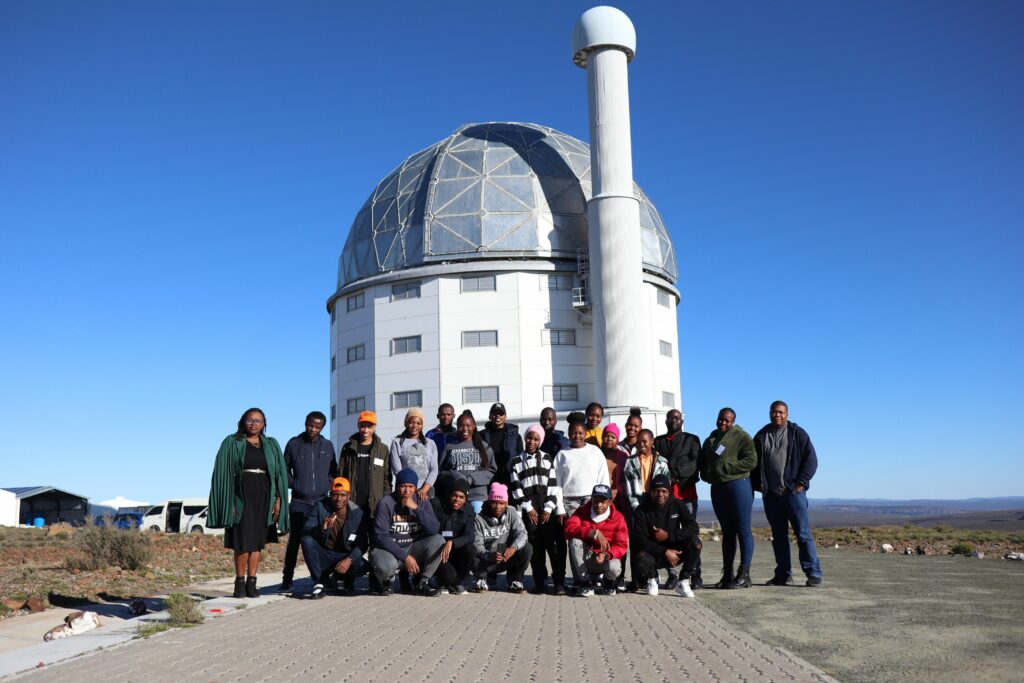
We recently caught up with some of the NRF|SAAO volunteer postgraduate students who participated in the open nights public program from 2009 until just before Covid-19 to explore how participating in the public program impacted their outlook on science engagement and what lessons they took with them to their respective professional lives. This is key since science engagement is considered mandatory in South Africa for national science institutions. Many of them belong to the African Astronomical Society (AfAS), which takes outreach equally seriously, and some are now based elsewhere on the continent. Science is in a myriad ways considered part of people’s everyday lives, therefore it is no wonder that it is viewed as fundamental to our societal knowledge. The Department of Science, Technology and Innovation’s (DSTI) science engagement strategy also sees society as the ultimate beneficiary of scientific innovation, and it therefore should be part of the conversation.
All the responses are from postgraduate students who were based at the Observatory, most of whom volunteered to help at the open nights, held every second and fourth Saturday of the month. Their roles varied from talking to the public about astronomy, to school visits and stargazing with the small telescopes as well as the McClean telescope. Their supervisors also encouraged them to participate in the program because science communication is an essential skill in making science accessible. Dr. Zara Randriamanakoto came to South Africa for her honours and she is currently a staff astronomer at NRF|SAAO. She learned, “the importance of communicating astronomy and that it should be considered seriously because of its crucial role in connecting society and the scientific astronomy community. Therefore, it is vital to think deeply about outreach activities and choose the content topics that are best suited for the target groups.”
She went on to explain her personal development, “I also gained invaluable skills by getting involved with community outreach during my postgraduate journey. I had the opportunity to strengthen my communication and organisational skills. One also learns to work effectively as a team by collaborating with other volunteers. This experience gave me a broader perspective on how to build strong and meaningful social connections as a scientist.” She is also the founder of Ikala STEM-Madagascar, an initiative whose aim is to advance scientific knowledge and promote careers in science, technology, engineering and mathematics (STEM) (https://www.ikalastem.org/history).
Sibusiso Mdhluli’s perspective is that he gained valuable communication skills that have become instrumental in his outreach work in his home province, Mpumalanga. Through community engagements he mastered the skill of explaining complex astronomy concepts in simple, relatable ways, an approach that has had significant impact on the learners and teachers he is currently working with through the Acornhoek Institute for Science and Technology (AIST).
One of the most rewarding experiences for him was conducting stargazing sessions and talking about celestial objects. According to Sibusiso Mdhluli, “it has been powerful to watch how observing the night sky can spark curiosity and deepen interest in science among learners who previously had little exposure to astronomy.” Additionally, the acquired communication techniques and hands-on activities have helped make astronomy more accessible and exciting for rural learners and educators alike. Today, the programs at AIST benefit directly from the lessons learned at NRF|SAAO, from simplifying scientific language to making space science feel close to home, he explained.
Dr. Elizabeth Naluminsa, a lecturer at Makerere University, Uganda and former Southern African Large Telescope postdoctoral fellow, joined the open night crew during her honours year with the National Astrophysics and Space Science Programme (NASSP) and stayed on until the early stages of her PhD studies.
She found engaging with diverse groups of people of different ages, educational backgrounds, and personal inclinations very interesting. The experience sharpened her versatility in communication. Furthermore, the open nights became a time for socialising and forging friendships and networks with fellow students from other universities as well as other departments and faculties within her own university. Being a foreign student, and trying to understand the new place of residence, these interactions were invaluable, as they provided a place where she could enjoy both the science and the humanity in the career she was pursuing so far away from Uganda.
“Perhaps this was also helped by the fact that outreach always reconnects us with the human side of the science we do, in terms of communication and not to mention the pretty astronomy pictures.” Just like the members of the public, she was once fascinated by gorgeous pictures which is what lured her to astronomy. On those Saturday nights, together they faced challenges, learnt new knowledge and watched their outreach skills develop and celebrated the wins collectively. Any apparent lows were considered learning opportunities, not losses. “So I could say the open nights enabled me to settle well into the astronomy community. It gave me a sense of belonging, a sense of community within the astronomy world, which very likely helped me fight the infamous imposter syndrome that so often plagues graduate students” she added. Moreover, given that she had no solid prior training in astronomy, the conversations and connections formed with other students at the telescopes on the lawn and in the dome positively contributed to her studies especially with regard to observational techniques and data reduction.
“Interestingly, before this, I had never engaged in this kind of public outreach before (except for a few public lectures here and there, just not hands-on science communication and random, intentional scientific discussions with the public). And yet, I felt so at home with the entire arrangement, perhaps thanks to the good training we got from the organisers. Sure enough, after my PhD studies, I went back home and conducted astronomy outreach in my home district following the same model. I must mention that the materials which my team and I used during those activities in my home district were generously provided by the SCBP and OAD offices.”, Dr. Naluminsa explained. Additionally, the volunteer work at the SAAO open nights taught her most of what she knows about science communication – the what, the how, the do’s, the don’ts, and the inbetweens.
Dr. Zolile Mguda who is now based at the University of South Africa (UNISA), views the road to becoming an astronomer as very long and sometimes arduous. Part of the skills that one learns, in this journey, is the ability to create a community around oneself. Even if it is not a community, one must be surrounded by people who share the same specialisation.
“I had office mates with whom I could share my frustrations and from whom I derived great motivation. I had friends who were postdoctoral fellows who, in retrospect, helped me understand that the road was not only hard for me but for everyone. These are people who had gone to school in faraway lands and had attended the best universities in the world”, he said. As an extension, doing the outreach evenings was good for the soul. Seeing fellow South Africans taking an active interest in astronomy brought the realisation that one was a cog in an ever-growing chain. Sharing knowledge with enthusiasts revealed that there is beauty in astronomy without minimising the challenges that follow the pursuit of knowledge. The spirit during the outreach events was always jovial, even during times when things were not going smoothly. The benefits were meaningful and bigger than one could quantify.”
The science engagement strategy categorises its priorities according to different levels of society. At the school level, the focus is on science, technology, engineering, and mathematics. At the public level, society is considered a key beneficiary of knowledge derived from research. The NRF|SAAO Open Nights have a long history. It makes us proud to know that many of the postgraduate volunteers who joined in over the years are still involved in science engagement.